Best Crabgrass Killer Post Emergent: Top 5 Solutions for Lawn Care
If crabgrass and other broadleaf weeds threaten your turf, choosing a post-emergent herbicide can stop them in their tracks. This guide highlights five effective post-emergent products designed to kill existing crabgrass and other common weeds while protecting healthy grass. Each option below is evaluated for broad-spectrum control, residual performance, and practical application notes to help American homeowners select a reliable solution for a lush, weed-free lawn.
Summary of Selected Products
| Product | Active Focus | Formulation Type | Notes |
|---|---|---|---|
| BASF Drive XLR8 Crabgrass Killer | Quinclorac | Post-emergent herbicide (concentrate) | Up to 30 days residual, rainfast quickly |
| Liquid Harvest Mesotrione | Mesotrione | Concentrate, pre/post-emergent | Broadleaf and grassy weed control; flexible use |
| Atticus Torocity Herbicide | Mesotrione | Concentrate, pre/post-emergent | Wide application window; strong weed spectrum |
| Agrisel Sulfentrazone 4F | Sulfentrazone | Pre- and post-emergent | Long-lasting control; treats 100+ weeds |
| Agrisel GlyPhoSel Plus Weed Killer | GlyPhoSel (glufosinate-like mix) | Post-emergent | Leaves no treated weeds behind; fast action |
Note: All products listed are evaluated for effectiveness against crabgrass and common lawn weeds, with practical tips for safe use in typical American home lawns. Always follow label directions for timing, weather conditions, and any site-specific restrictions.
BASF Drive XLR8 Crabgrass Killer

BASF Drive XLR8 is a post-emergent herbicide formulated for quick, visible weed control in turf areas. The water-based formulation supports rapid plant uptake, and the product provides up to 30 days of residual control. It targets crabgrass and a broad spectrum of broadleaf weeds, including bindweed, dandelion, and clover, while delivering fast rainfast performance in under an hour. This makes it suitable for lawns that face frequent weed pressure and variable rainfall.
Liquid Harvest Mesotrione

Mesotrione-based Liquid Harvest offers flexible application timing with post-emergent action against crabgrass, broadleaf species, and various grasses. The product is designed to work quickly after application, but full weed death may take 2–3 weeks. Activation requires water; if rainfall is insufficient within 10 days, light irrigation is recommended. It is suitable for multiple turf types, including Kentucky Bluegrass and Tall Fescue, with some exclusions based on grass species and lawn conditions.
Atticus Torocity Herbicide
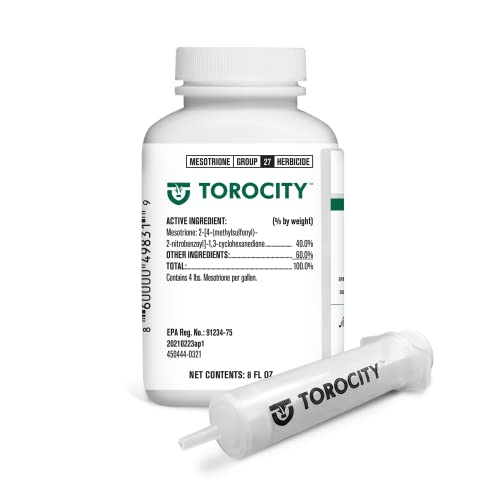
Atticus Torocity combines mesotrione with a flexible application window that supports both pre- and post-emergent weed control. While primarily marketed for post-emergent use, its dual-action timing makes it a forgiving option for lawns facing ongoing weed challenges. It provides broad-spectrum control, including crabgrass, clover, oxalis, and dandelion, helping to maintain uniform turf color and density when weeds threaten young or established lawns.
Agrisel Sulfentrazone 4F Weed Killer

Agrisel Sulfentrazone 4F is a versatile pre-emergent and post-emergent formula designed for broad-spectrum weed control. It targets a wide range of weeds, including crabgrass and other common lawn invaders, while offering long-lasting residual activity. The package often includes protective gloves, emphasizing safe handling for homeowners conducting routine lawn maintenance across various spaces, such as residential lawns, golf courses, and roadside areas.
Agrisel GlyPhoSel Plus Weed Killer

Agrisel GlyPhoSel Plus is a post-emergent herbicide designed to eliminate established weeds from leaf to root, with a focus on non-crop areas. It is noted for long-lasting residual action and suitability for driveways and fence rows, where weed pressure can be persistent. The product is sold with protective gloves, underscoring intended handling precautions for homeowners applying weed killers in varied outdoor spaces.
Buying Guide: Key Purchase Considerations for Post-Emergent Crabgrass Control
When selecting a post-emergent crabgrass killer for a home lawn, consider the following factors to align with your turf type, climate, and weed pressure:
- Weed spectrum: Some products target only crabgrass, while others cover a broader range of broadleaf and grassy weeds. Choose based on the most problematic weeds in your yard.
- Grass compatibility: Ensure the product is labeled for your grass species (fescue, bluegrass, bermudagrass, etc.) to minimize turf injury.
- Post-emergent versus pre-emergent balance: Post-emergent options control existing weeds, but some formulations also provide pre-emergent or residual effects to prevent new germination.
- Residual duration: Longer residual control reduces the frequency of applications but may require more careful timing to avoid stressing the lawn during peak heat.
- Rainfast and weather tolerance: Quick rainfastness helps performance after application, especially in regions with unpredictable rainfall.
- Application timing: Some products work best on actively growing weeds; others offer flexibility for pre- or post-emergent use.
- Safety and gloves: Look for included protective gear or recommended safety equipment, particularly for concentrated formulations.
- Site considerations: Consider non-turf areas (driveways, sidewalks, garden beds) where post-emergent control may be necessary, and ensure label restrictions are followed near ornamentals and edible crops.
- Usage limits and re-entry intervals: Review any waiting periods before children or pets can re-enter treated areas.
In practice, the best choice depends on your lawn’s grass type, weed species, and local climate. For homeowners seeking strong post-emergent performance with a broad weed spectrum, products featuring mesotrione or quinclorac-based chemistry often provide effective control with manageable safety considerations. Always read the product label for target weeds, application rates, and site-specific instructions before use.